Hey trader,
Thursday morning gave us a bounce that looked healthy until I checked net capital flow. The market had gapped lower, and prices were climbing back during the 10% Club.
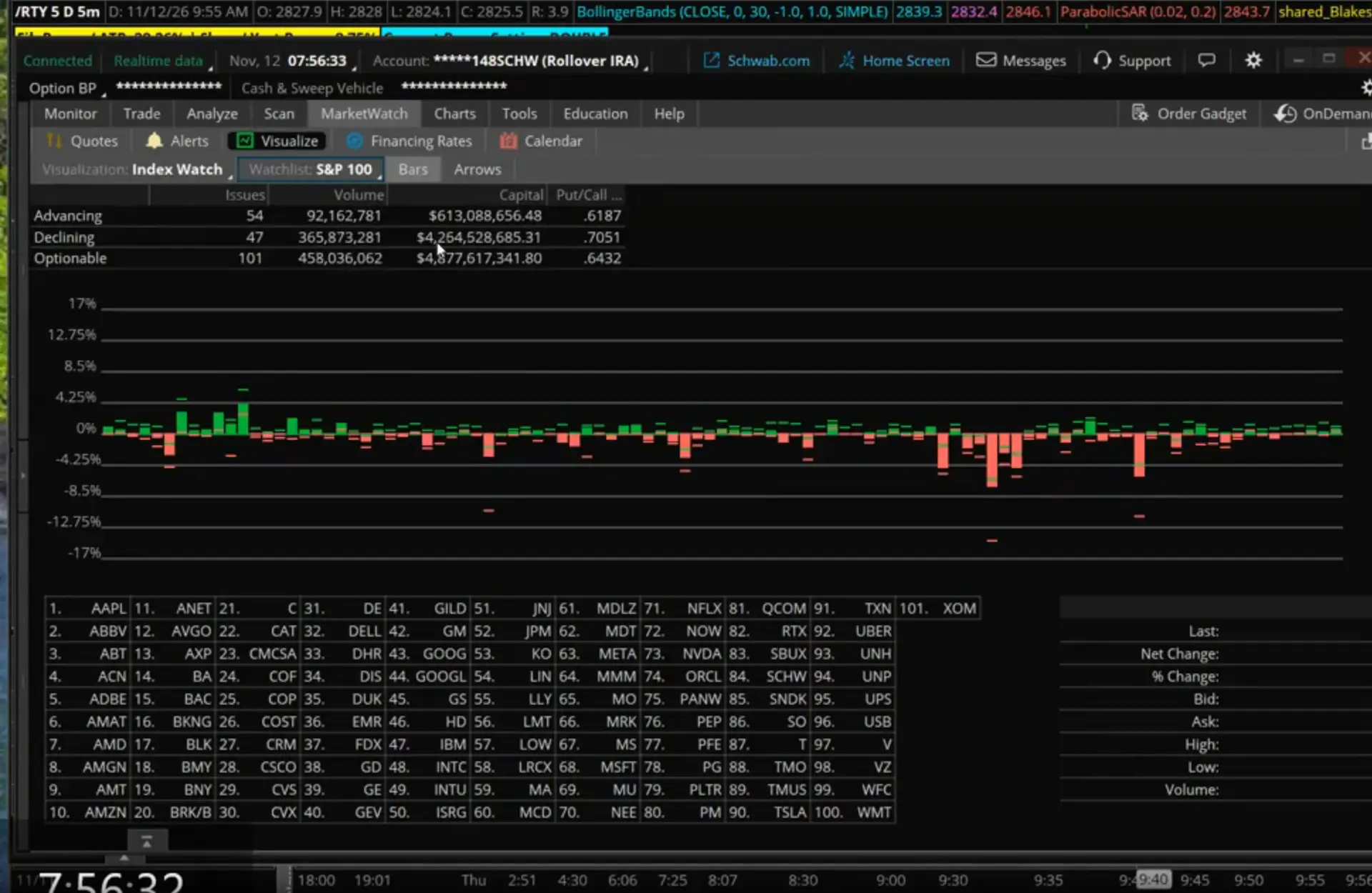
The advance-decline count backed that bounce up, with 53 stocks in the S&P 100 rising and 48 falling. That count tallies how many stocks are up and how many are down, and more green usually reads like buyers are back.
I didn’t trust it, because net capital flow told a different story. Even with more stocks rising, $3.6 billion was leaving those same stocks.
A little later, that outflow reached $3.8 billion.
The two numbers disagreed because of how the count works. It gives every stock one vote, no matter how much money moves through it.
On Thursday, that meant NVIDIA, a multi-trillion-dollar company down 7%, counted the same as Danaher up 0.08%. The count treats a giant’s selloff and a tiny gain as equals.
Buy a bounce on that count alone, and you could be buying right as the biggest money heads for the exit.
That’s why I watch net capital flow, the dollars moving into or out of stocks. On Thursday, it told me the bounce probably wouldn’t hold.
Here’s where I pull that number up and how I use it to tell a real bounce from one the big money is selling into.
Click Here to Continue Reading
P.S. Inside the 10% Club, you watch me read the money and the chart live, then call my trades in the first hour.
On Thursday, members saw me flag the $3.6 billion leaving the market while the bounce was still running. Every morning, you also get my charts with the beacon levels already marked.
Right at the end of Thursday’s session, I walked through an XSP setup aimed at filling the gap. XSP is the mini S&P 500 index option, and one member traded it and closed it for $1,870.
Why The Advance-Decline Count Misses The Money
The advance-decline count only asks whether each stock is up or down on the day. On Thursday, it kept flipping as stocks crossed back and forth over flat.
At one point it read 49 up and 52 down.
Share volume doesn’t rescue the count either. By that point Thursday, NVIDIA had traded 329 million shares at about $160, while Danaher had traded about half a million.
I told the room I don’t see much value in either the issue count or raw volume. What I want to know is net capital flow, meaning how many dollars are moving.
Before I trust a bounce, I check how much money is behind it.
Where I Check Net Capital Flow
I pull net capital flow from the Market Watch heat map in Think or Swim. From there, I open Index Watch and select a watch list.
I use the S&P 100 for everything.
That screen also shows advancers, decliners and volume. I skip past them and go straight to the net capital flow figure, which shows how much money is moving into or out of those stocks.
I can’t chart net capital flow over time yet, because the data is proprietary. I told the room I’d love to chart it the way I chart price.
What Capital Flow Told Me Thursday
In the 10% Club, prices had gapped down and were pushing back toward the gap. All that buying never reversed the $3.6 billion leaving the market.
I told the room I expected the bounce to fail and drop again.
The money looked like it was heading to cash, with the dollar gaining and the euro falling.
Some of the move was rotation, meaning money shifting out of one group of stocks and into another. Broadcom, Amazon and AMD were rising while money rotated away from Micron and NVIDIA.
By the main room later that morning, the bounce had pulled about $2 billion onto the buyer side. Net capital flow still showed about $4 billion going out.
NVIDIA had climbed from nearly 8% down to about 5% down, while Micron was off about 25 points and SanDisk about 40.
That recovery hadn’t undone the outflow.
That shaped my plan for both directions. If I’m bullish, I want the names pulling in that $2 billion.
In the names bleeding money, I’ll fade the rally when it sets up. Fading a rally means selling or shorting into it because I expect it to stall.
Net capital flow doesn’t hand me an entry, though. In the 10% Club, I told the room I didn’t have a trade signal or a risk management point, meaning a level to set my stop.
I never placed a trade off this read before the session ended, so there’s no result to report.
Run The Net Capital Flow Check Before You Buy A Bounce
Here’s the check I’d run the next time a bounce looks convincing:
- Read the net dollars first. Pull up net capital flow on a large list like the S&P 100 and note the total.
- Compare it to the move. If price climbs and the outflow doesn’t shrink, treat the bounce with suspicion.
- Follow the money in. If you want to be bullish, focus on the names pulling dollars in.
- Wait for your signal. Net capital flow sets your bias, and your entry still needs a signal and a stop.
Some traders layer up-volume and down-volume readings on top of the count. Those tools can help, and that top-level tally still doesn’t mean much to me.
That’s my line, and it doesn’t have to be yours.
When price bounces and the money keeps leaving, I look to fade the rally.
On Thursday, a member asked about the advance-decline count, and I walked through my answer live. You heard why I trust dollars over the tally while the market was still open.
Inside the 10% Club, I call trades in the first hour off three main signals. You also hear the capital flow read and the market context as I work through each setup.
Check where the money’s going before you trust the bounce.
Blake Young
Senior Market Strategist, TheoTRADE