
Hey trader,
The whole week on the Nasdaq hinges on a single level at 690.
When a market drops this fast, the natural move is to buy the dip. The trouble is that the one thing that normally slows a fall has quietly gone missing.
Above the market sit big stacks of call options that work like brakes. The firms on the other side hedge to stay balanced, and that holds the tape steady.
Looking at today’s options chain I can say this: below 690, those brakes are gone.
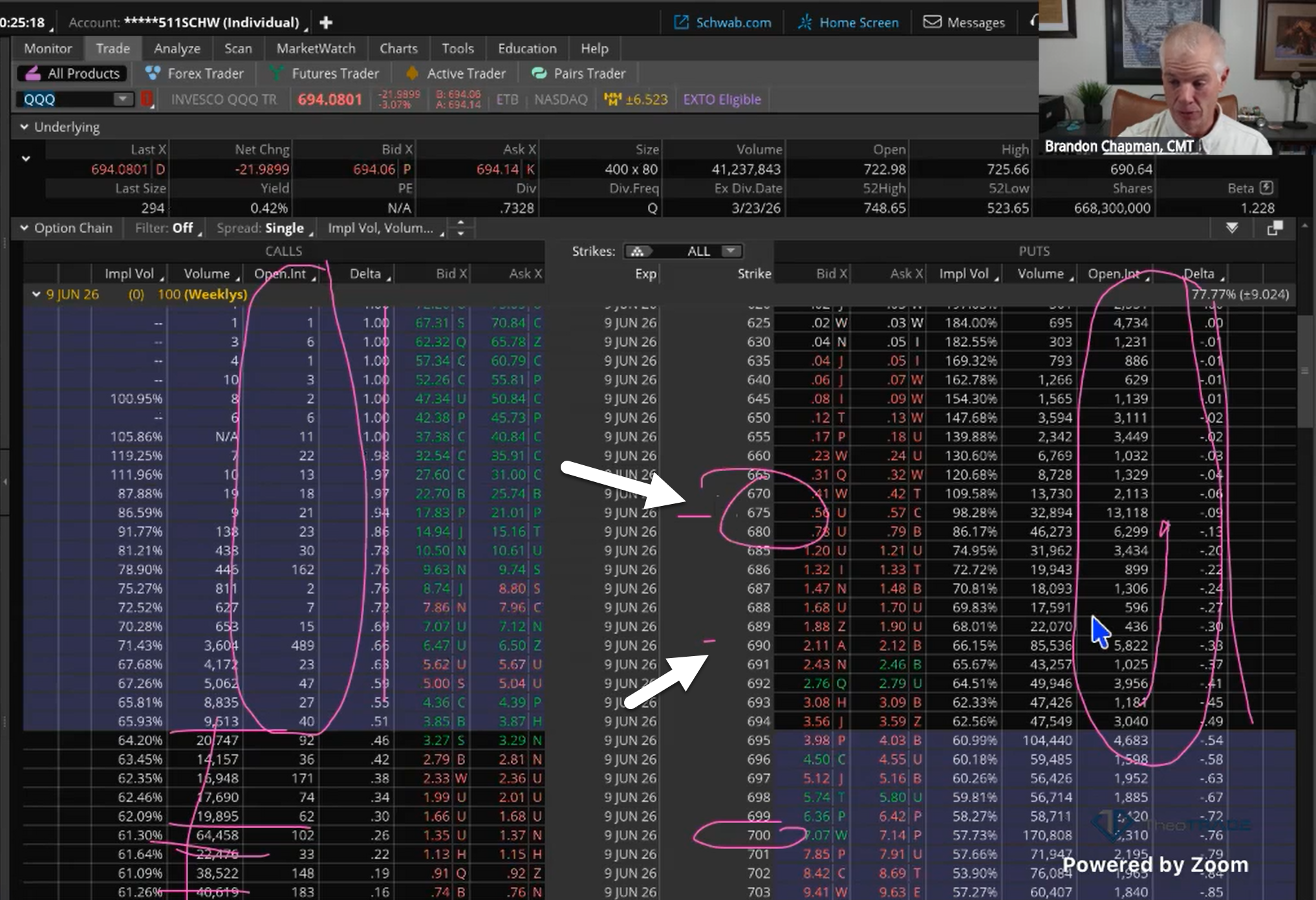
A break of that level leaves nothing to catch the Qs. The next heavy cluster of options sits all the way down at 675.
I read that setup on the gamma structure before the chart shows any of it.
If 690 breaks, there is a clean, defined-risk way to play the slide. And I’m going to walk you through how I get there.
Why There Are No Brakes Below 690
690 is the lowest price level that still has support under it. Price has leaned on it and steadied there.
Above the market, traders hold big stacks of call options that are already sold. The firms on the other side buy and sell stock to stay balanced, and that buying and selling holds the tape steady.
Below 690, those call options are not there.
For this week’s expiration, almost everything under the market is put options. The Qs have run past the last level where any calls could slow them down.
Where The 675 Target Comes From
The next heavy stack of options sits at 675. It is the biggest one on the Nasdaq board.
A cluster that size acts like a magnet in a falling market. It pulls price toward it, the same way 740 pulled the S&P 500 lower last Friday.
I run it off yesterday’s close of 716.07. A move to 675 is a 5.7% drop.
That is the open air that sits below a clean break of 690.
The picture leans the same way every expiration out. Tomorrow has call options stacked only up at 709 and 710, with far more puts underneath.
End of week shows nothing of size until 705, which holds 20,000 contracts against just 2. Even the June 18 expiration reads weak at 690 and 695.
The Trade
I want to be clear that this is a framework, not a fixed call.
The whole thing depends on whether 690 holds, so I would size a defined-risk position, meaning one where I know my maximum loss going in, and confirm the strikes and price at entry.
- Setup: the Qs sitting right on 690, the lowest price level that still has support under it
- Trigger: a drop through 690, followed by a bounce that fails to get back above it
- Target: 675, about 5.7% below yesterday’s 716.07 close
- Invalidation: a move back above 690 that sticks, which tells me buyers are back and the trade is wrong
- Edge: below 690 there are no call options left to slow the fall, so the drop toward 675 has little in its way
What To Carry Forward
The Qs are sliding from one price level to the next, and that drift lower will not stop on its own. That is the trap for everyone trying to call the bottom here.
The S&P 500 tells the same story. There are no call options stacked above to act as brakes this week, a heavy band of puts sits at 730, and the market does not steady until 750.
The one thing I can count on is what the big firms have to do. As price keeps dropping through each level, they are forced to sell more stock to stay balanced, and that selling repeats every time a level breaks.
I see room for the VIX, the market’s fear gauge, to climb toward 30 from here.
I would not trust the move into safe-haven names either. Once a real correction takes hold, almost everything sells off together, and those defensive stocks get dragged down with the rest.
The plan from here is simple. I am watching 690 in the Qs. A drop through it that fails to recover opens the path to 675.
Brandon Chapman, CMT
Creator of Ghost Prints