Hey trader,
Silver has been trailing gold for weeks, and most traders scanning flow have moved on from it entirely.
That’s exactly the environment where a 9,999-contract print stands out.
The macro backdrop has been shifting quietly.
The MOVE Index, the bond market’s version of the VIX, peaked on March 26th and has been declining.
When bond volatility drops alongside a softening dollar, silver has historically responded. Institutions watching that correlation don’t wait for the headlines to confirm it.
The Block Hunter Console flagged 9,999 call contracts bought on SLV at the $80 strike for May 22nd expiration.
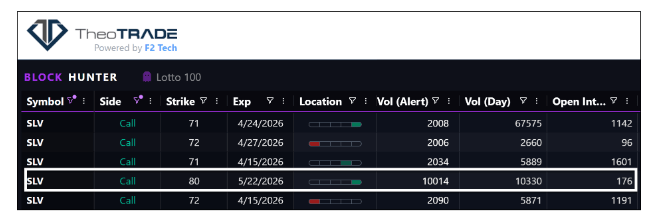
The print carries a 36 delta, meaning market makers who sold those calls are already buying shares to hedge their exposure.
This wasn’t the only print.
Last Friday, the Console flagged 13,563 contracts bought in SILJ, the silver junior miners ETF. Sold puts and bought calls, 15,000 total contracts for that session.
Two prints. Four days apart. The same corner of the market.
There’s one more layer.
Buying calls outright in SLV right now doesn’t work. Implied volatility is elevated enough that the math turns against a naked long call buyer even if the direction is right.
What the Prints Tell You
The Console flagged 9,999 call contracts bought on SLV at the $80 strike for May 22nd. Volume confirmed this as an opening position.
The $80 strike sits roughly $8 above SLV’s current price near $72.
At a 36 delta, the contract sits close enough to the current price that market makers must actively hedge their short call exposure from the moment the trade executes.
That hedging is mechanical and ongoing.
Every dollar SLV moves higher, the delta increases and the required hedge grows.
Last Friday, the Console captured 13,563 contracts in SILJ, the silver junior miners ETF, structured as sold puts and bought calls.
Total volume for that session reached 15,000 contracts. The SILJ print did not exist in isolation. It was the first chapter of a thesis that continued with today’s SLV print.
When the same directional bet appears across a sector ETF and its underlying commodity vehicle within four sessions, the conviction behind the positioning becomes harder to dismiss.
Why the MOVE Index Changes the Setup
The MOVE Index tracks volatility in the U.S. Treasury bond market. It is the bond market’s equivalent of the VIX.
The MOVE peaked on March 26th and has been declining since.
A falling MOVE Index signals that the fear premium embedded in bond markets is coming off.
That relief tends to flow into real assets, and silver sits at the intersection of monetary sensitivity and physical demand.
The VIX itself is down to 18 today, retreating from elevated levels earlier this month.
Falling volatility across both equity and bond markets removes a key headwind for silver. When dollar softness layers on top of that, the metal has historically moved with momentum.
The institution behind the $80 print sized the position for that kind of move. A trade of this scale requires a directional thesis, not a hedge.
Why Elevated IV Makes the Spread the Only Viable Structure
Buying a call outright in SLV doesn’t work in the current environment.
Implied volatility is high enough that even if SLV reaches $80, the math on a naked long call works against you. The premium you pay today erodes the return significantly.
The spread solves that problem.
By selling a higher strike against the long call, you collect premium at a richer implied volatility level than you paid.
The net cost drops, and the structure becomes viable where the naked call was not.
Positive skew in SLV compounds the edge. Implied volatility rises as you move further out of the money on the call side.
That means the strike you are selling carries richer premium than the one you are buying. The skew is working in your favor at both ends of the trade.
How to Structure the Trade
The institutional print targets $80 for May 22nd. The spread below uses May 15th and a tighter target, capturing the move at lower cost with a high probability of success.
- Buy: SLV May 15 $74 call
- Sell: SLV May 15 $76 call
- Spread width: $2
- Cost: Approximately $0.68
- Max risk: $0.68 (the debit paid at entry)
- Target: $1.16 (approximately 70% return on the spread)
- Probability of touching $76: Approximately 71%
- Skew edge: Buying lower implied volatility, selling higher
- Direction: Bullish
- Catalyst: 9,999-contract institutional call print at $80, SILJ buying from last Friday, MOVE Index declining from March 26th peak, dollar softening
SLV does not need to reach $80 for this spread to produce a return.
A move toward $76 puts the sold strike at the money and accelerates the value of the lower leg.
The 71% probability of touching $76 gives you a high-confidence structure at a clearly defined cost.
If the spread reaches the $1.16 target before expiration, close the trade.
Silver can move sharply when macro conditions align, and locking in the gain early removes the risk of giving it back.
What the Console Is Tracking Now
The Block Hunter Console flagged the 9,999-contract print and confirmed through the 36 delta that market maker hedging is active from the moment the position opened.
The SILJ print from last Friday confirmed directional conviction in the same space four sessions earlier.
Positive skew makes the spread cheaper than a flat-volatility environment would price it. Buying call options outright in SLV doesn’t pencil out right now.
The spread structure captures the same directional thesis without the volatility drag working against you.
The MOVE Index decline and dollar softening create the macro conditions that have historically driven silver higher. The institutional print at $80 tells you where one major player expects this to go.
The spread gives you the structure to position alongside that conviction for 68 cents of risk.
See exactly how Block Hunter catches institutional positioning before the crowd catches on.
Brandon Chapman, CMT
Creator of Ghost Prints