Hey trader,
The biggest SPY put print of the day hit while the S&P 500 was still climbing on Iran ceasefire headlines.
A 3% gap higher looked like relief to most traders. The institution behind this print used the rally to buy cheaper put premiums.
The Block Hunter Console flagged 110,000 put contracts bought on SPY in two prints by the same trader.
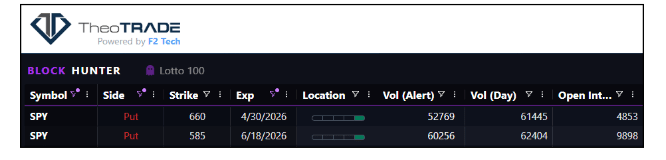
The fills landed at the April 30th, $660 strike and the June 18 585 strike, both confirmed as opening positions.
The VIX dropped to 20 during the session. A 30-delta put on SPY normally costs $5 to $6. Right now, that same put runs $8.50 because implied volatility is still elevated.
The atomic hedge uses that pricing window to protect $100,000 in equity exposure for $274 out of pocket. The VIX at 20 is the ingredient that makes the math work.
What 110,000 Contracts Tell You About the Rally
The Console flagged 50,000 put contracts at the April 30 660 strike and 60,000 at the June 18 585 strike. Both prints executed at the same timestamp, confirming a single trader.
Volume exceeded open interest at both strikes. These were new positions, not rolls.
The April 660 puts carried a 21 delta. The June 585 puts carried zero.
The 660 leg provides working protection over the next three weeks. The 585 leg sits far below the current price and functions as crash insurance through mid-June.
That two-layered structure tells you the institution expects near-term downside risk while maintaining protection against a larger decline on a longer time horizon.
So, it makes sense to create a hedge just in case the headlines aren’t all they’re cracked up to be.
How to Structure the Atomic Hedge
The atomic hedge pairs long puts with short call verticals. The call vertical credit offsets a portion of the put premium, leaving a small out-of-pocket cost.
For a $100,000 portfolio holding S&P 500 exposure, the structure uses the May 15 expiration with SPY near 675.
- Portfolio: ~148 shares of SPY ($100,000 in S&P 500 exposure)
- Buy: 2x SPY May 15 656 puts ($844 total)
- Sell: SPY May 15 call verticals, $6 wide at the 40-delta short strike ($570 total credit)
- Net cost: Approximately $274
- Delta reduction: From 148 to approximately 88 (a 40% reduction in directional exposure)
- Catalyst: 110,000-contract institutional put print, VIX compression on ceasefire rally, oil forward premium still elevated despite two-week agreement
If SPY rallies 10% to 742, the hedge creates approximately $2,800 of drag on the portfolio. If SPY stays flat through expiration, the cost is $274.
Below 656, the puts begin accelerating in value and offset losses in the underlying equity. That is where the structure shifts from costing money to generating returns.
The management is straightforward. If volatility spikes and the call verticals drop to around $0.30, buy them back to remove the upside cap while the puts remain in place.
If SPY declines below 656, sell the in-the-money put and buy a new 30-delta put approximately 30 days further out. The target is approximately $1,000 in credit on the roll, extending the protection window while reducing the cost basis of the hedge.
The 3% rally was driven primarily by short covering on light volume.
The Iran ceasefire is a two-week agreement with details still being negotiated. Both sides are claiming victory, and the damage to oil supply chains is already embedded in the futures curve.
Why the VIX at 20 Creates the Window
A 30-delta put on SPY normally costs between $5 and $6 at historical volatility levels. In the current environment, that same put runs approximately $8.50.
The VIX at 20 is still elevated. The cost of protection reflects that.
But the VIX was higher yesterday. The ceasefire announcement compressed premiums enough to shift the math on a hedging structure that requires lower vol to function.
Green days reduce implied volatility. Reduced implied volatility lowers the cost of puts.
The institution behind the 110,000-contract print timed its entry to the session where premiums were at their lowest point in weeks.
What the Console Is Tracking Now
The Block Hunter Console flagged both prints and confirmed through volume exceeding open interest that the positions were new. The fills landed at the same timestamp, linking them to a single trader building layered downside protection on a rally day.
The ceasefire rally compressed the VIX to 20 and gave the institution a pricing window for 110,000 contracts. The atomic hedge gives you the same window for $274 of out-of-pocket cost.
See exactly how Block Hunter catches institutional positioning before the crowd catches on.
Brandon Chapman, CMT
Creator of Ghost Prints