Hey trader,
The dealer hedging obligation on Citigroup just expanded by 20,000 contracts in a single print.
The stock is already up 29% off its March lows. Implied volatility sits at 36%. Most traders would not touch it here.
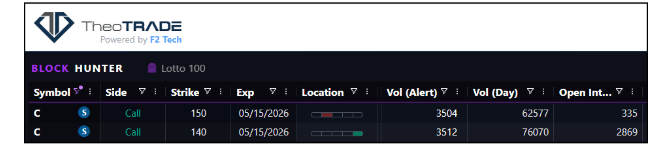
The Block Hunter Console flagged the print at 9:39 AM.
Someone bought 20,000 calls at the $140 strike and sold 20,000 at the $150 strike as a single spread trade. The market maker on the other side is now short those calls and must buy stock to hedge.
The delta on the $140 strike sits at 28.
Every dollar Citigroup moves higher forces the dealer to increase that hedge, and the buying compounds the move.
Negative skew on calls makes buying them outright expensive, but a $135/$140 call spread costs $1.67.
What the Print Tells You
The Console flagged 20,000 call contracts bought at the $140 strike and 20,000 sold at the $150 strike for May 15 expiration. Both legs executed as a single spread trade at 9:39 AM.
Volume exceeded open interest at the $140 strike when the alert triggered. The position is confirmed as new.
Citigroup was trading near $130 when the print landed. The $140 target sits roughly 7% above the current price with 30 days until expiration.
Total volume at the $140 strike reached 73,000 contracts by midday, with the majority confirmed as bought. The 20,000-contract block was the largest single print within that flow.
The Console also captured call buying on Citigroup near the March lows before the 29% rally. The same directional thesis is being reinforced at higher prices with a larger position size.
Why the Gamma Mechanics Create Upside Pressure
The market maker who sold 20,000 calls at the $140 strike is now short gamma on Citigroup. The 28 delta on those calls means the dealer must buy shares to offset the directional exposure.
That hedging is not optional. It is mechanical.
As Citigroup moves toward $140, the delta on those calls increases. The dealer must buy more shares with every dollar of movement, and that buying adds upward pressure on top of whatever forces are already driving the stock.
The net delta difference between the $140 and $150 legs is approximately 20. That spread represents the range over which the dealer’s hedging obligation grows most rapidly.
Citigroup just reported earnings and gapped higher. The institution behind this print committed capital to a position that requires the stock to hold above $130 and push toward $140 within 30 days.
Why Negative Skew Shapes the Trade Structure
Implied volatility on Citigroup puts is rising while call volatility is falling. That negative skew creates a specific problem for directional call buyers.
A call ratio backspread, which normally benefits from this kind of institutional conviction, does not produce a credit at the available strikes. The $5 strike spacing is too wide to generate favorable pricing on either the $135/$140 or $130/$140 configurations.
A short put vertical at the $130/$125 strikes collects $1.73 in credit but carries $327 of risk. Targeting 70% of that credit brings the realistic profit to $1.21 against the full $327. The risk-to-reward ratio approaches 2.7 to 1.
The long call vertical reverses that dynamic.
How to Structure the Trade
The $135/$140 call spread captures the institutional thesis at half the risk of the short put vertical for a comparable profit target.
- Buy the C May 15 $135 call
- Sell the C May 15 $140 call
- Spread width: $5
- Cost: Approximately $1.67
- Max risk: $1.67 (the debit paid at entry)
- Target: 70% of max gain (approximately $1.20 profit)
- Probability of touching $140: Approximately 50%
- Direction: Bullish
- Catalyst: 20,000-contract institutional call spread, dealer gamma hedging obligation, earnings momentum, prior call buying confirmed near March lows
Citigroup does not need to reach $150 for this spread to produce a return. A move toward $140 accelerates the value of the $135 call while the sold leg approaches the money.
If volatility declines as the stock rises, the spread benefits further. A 5% drop in implied volatility increases the profit at $140 from approximately $128 to $147.
If the position reaches the 70% gain target before expiration, close it. The institutional print provides the target. The spread provides the structure.
What the Console Is Tracking Now
The Block Hunter Console flagged the 20,000-contract spread and confirmed through volume exceeding open interest that the position was new. The fills landed at 9:39 AM in a single execution.
The prior call buying near the March lows produced a 29% move. The institution behind today’s print is adding conviction at higher prices with a larger position.
The $140 target creates a gamma squeeze setup where dealer hedging compounds the upward pressure. The long call vertical gives you the structure to position alongside that conviction for $1.67 of risk.
See exactly how Block Hunter catches institutional positioning before the crowd catches on.
Brandon Chapman, CMT
Creator of Ghost Prints