Hey trader,
Friday morning, the 26 was setting up on the NQ.
I had my buy stop at 26 and my risk level at 22.
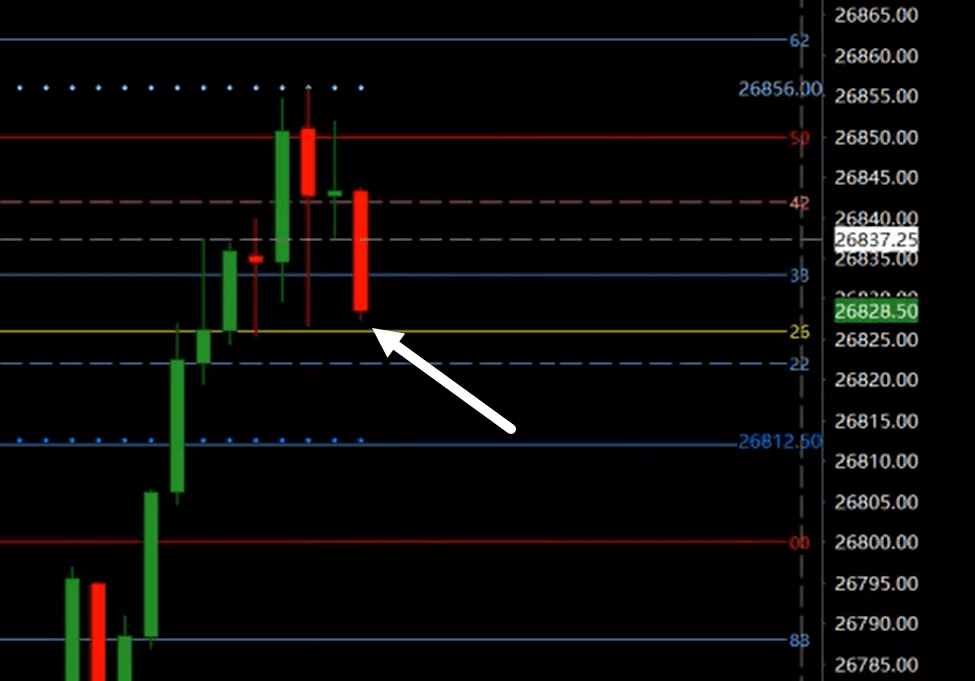
Volatility was elevated, news was hitting the tape, and the room was watching every tick.
Price came down to 22. It kept going. It touched 18, then 16.
Instead of letting my order get picked up, I canceled it.
Then I turned to the room. “We just avoided a stop loss.”
That single moment is the whole point of this newsletter.
Why the Back-Through Matters More Than the Entry Itself
On a normal tape, a 26 long is a resting order. You place a buy stop at 26, your risk is 22, and you let it fill. Risking four to make 24 is a 6X trade. That math is the whole reason the setup works.
The problem is that “on paper” assumes the tape cooperates.
When Trump is tweeting every seven minutes and the NQ is printing 200-handle hourly bars, the tape stops cooperating.
You can be right about the level and still get flamed out by a news-driven wick that blows through 22 and then reverses back to your target without you.
The back-through entry is built for that exact scenario.
Instead of leaving a resting order at 26, you wait for price to touch 22, the invalidation level.
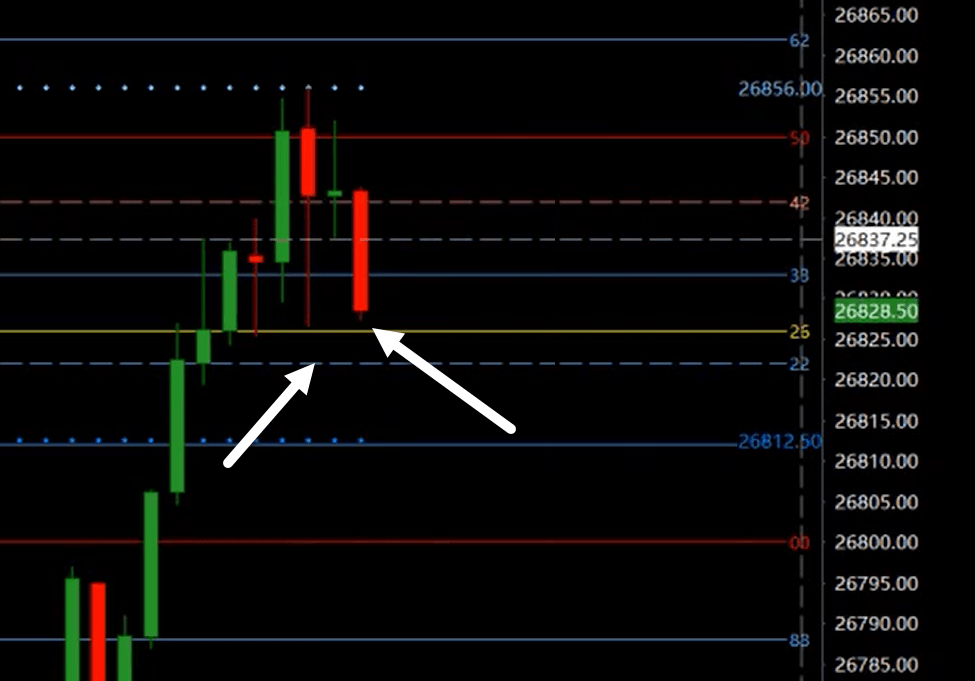
You do not have an order in the market at that point.
If 22 holds and price ticks back through 26, you place a buy stop at 26 and get picked up on the reversal. If price keeps dropping to 16, you never placed the order, which means you never lost a point.
Most traders miss that second half. The back-through does more than refine the entry. It lets you be wrong without paying for it.
What It Looked Like Today
The tape this morning was a 40 ATR right at the open. I told the Futures Room the rule was simple.
“Everything’s on a back through, you guys, especially counter. It’s still very much trendy to the upside.”
Later, in the Golden Setup session, the 26 setup I mentioned came around. It was the third test of the level.
My homework shows that 26 is resilient and will withstand multiple tests. A third test in an elevated ATR is exactly where the back-through earns its keep.
Price dropped straight to 16 without giving us a reversal bar. On a resting order, that is a minus 10 or a minus 15 depending on where your escape sits. Because I was using the back-through, the outcome was zero.
I said it to the room plainly. “On our homework sheet, that’s going to count as a minus 30. Not for us.”
That is the column we are trying to stay out of.
When to Use a Resting Order, When to Switch to Back-Through
Resting orders are fine on first and second tests of a level when the ATR is in a comfortable range, roughly 20 to 25.
That is the environment the setup was built around. You are reading a fresh level, you have a clean bounce coming, and you want the best fill possible.
You switch to the back-through when any of three conditions show up.
The first is a third test of a level, because the level has absorbed orders and the probability of a clean bounce drops.
The second is an elevated ATR, anything over 25 on the NQ. The third is news-driven hyper volatility, the kind we saw all morning with the Iran headlines and the Cloudflare outage.
Any one of those three is enough. When two or three show up together, the back-through is not optional. It becomes the only way to take the trade without bleeding capital on the false starts.
The Same Logic on the Short Side
This applies on the other direction too. We had a swing-and-a-miss short at 77 earlier in the morning. Our order was sitting there, price got to 76.75, and it blasted back up without filling us.
On a normal day, that is frustrating. On a back-through Friday, it is a signal.
The back-through short would be to let price push up to 82, place a sell stop at 77, and wait. If 82 rejects, your order fires on the move back through 77 and you ride it down. If 82 gives way and price runs to 87, you cancel the order. You sidestep the stop entirely.
Same mechanics, opposite direction. Your order only fills on a confirmed reversal, never on a slow bleed against you.
The Part People Miss
I told the room something today I want to repeat here. I am not spinning the narrative. I sit in front of you and lose just like anyone else. I took two full stops before I found the trade that made my day.
The back-through does not eliminate losses. It eliminates the losses that come from rushing into a level that has not yet proven it will hold.
On paper, the 6X math on a 26 long is beautiful. In practice, those 22s do not always hold, especially on a third test or during news. The back-through is the tool that keeps the math honest. It forces price to prove itself before your capital is on the line.
On a 40 ATR tape with news flying, a canceled trade is a win. The 26 I did not take today was as important to my P&L as the 26 I eventually did.
Next week the tape may calm down. The ATR may come back to 20. If it does, we will go back to resting orders on first and second tests and collect our 6X trades the easy way. If it stays wild, we already know what to do.
See you in the room Monday.
Trade smart,
Tony Rago
Creator of the Golden Setup