Hey trader,
Not every large print is a directional bet.
Reading flow correctly means knowing when an institution is positioning for a move versus when it is buying insurance on a long book.
Getting that wrong is how traders short a rally or fade a setup that was never there.
The Block Hunter Console flagged a 30,000-contract put vertical in SPY today at $703 / $689 for April 24 expiration.
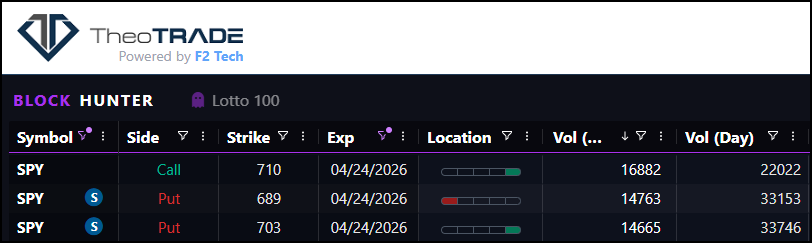
The long leg carried a 24 delta at entry. That is the tell.
An institution paid about $2 per contract to cap downside risk on a book that is three weeks past the expected move.
A VIX near 19 makes naked puts expensive, so they used a $10 wide vertical and scaled it for 30,000 contracts.
The same structure copies cleanly to a retail book.
The teaching is in why this shape works, how the roll extends it, and why the math runs the way institutions run it.
Reading Hedges in the Flow
Two numbers separate a hedge from a directional bet: the delta on the long leg and the width of the spread.
Directional trades usually carry a 30 to 50 delta, with a narrow spread of $2 to $5. The buyer wants maximum exposure to a move.
Hedges run lower. The long leg sits at 20 to 30 delta, and the spread stretches to $10 or more. Position size tends to be large relative to the open interest because the buyer is insuring a sizable book.
Today’s SPY print fits the hedge profile on every count.
The 24 delta on the long strike, the $14 wide spread, and 30,000 contracts across two coordinated blocks all point to one conclusion. This is protection being bought, not a short bet being placed.
The distinction matters because the two readings lead to opposite trades. Treat this print as bearish and you short SPY expecting a drop by April 24. That trade sits in the red while you wait for a decline the print never forecast.
A hedge caps downside on a long book that already exists. It does not predict a timed move.
The 30 Delta, $10 Wide, 30 Days Out Framework
Institutions hedge long positions with a repeatable recipe. Buy a 30-delta put, sell another put $10 below it, and place the trade about 30 days out.
Applied to SPY today with the index near $707, the structure looks like this:
- Buy the SPY May 20 $691 put
- Sell the SPY May 20 $681 put
- Spread width: $10
- Cost: approximately $1.87 per contract
- Max risk: $1.87
- Target exit: $6.00
You could hold for the full $8.13 max profit, but $6 is where most meaningful drawdowns actually land. Exiting there locks in the gain once the hedge has done its job.
One extra tailwind helps right now. Skew is rising as the VIX climbs, so the $681 put you sell fills at a higher implied volatility than the $691 put you buy. That shaves the cost of the spread.
Why the Roll Is What Makes the Hedge Work
A single put spread held to expiration caps your protection at the short strike. Once the market trades past that level, the hedge is done.
That is the part most traders miss the first time they buy protection. A one-and-done hedge works for one leg of a decline and nothing beyond.
The fix is the roll. If SPY falls and the spread climbs to $6, you close it and open a new 30-delta, $10 wide spread at the lower price. The first leg of the decline is banked, and you reset protection for whatever comes next.
You repeat this process for as long as the market keeps dropping.
You will not capture every dollar of the move. Realistic numbers land around 20% to 30% of a sustained downturn, which is plenty to offset losses in a long book without needing perfect timing.
Why Hedging Now Makes Sense
SPY has traded three straight weeks above its expected move. Last week ran more than twice the expected range, which is a stretch for any trend.
Several signals are turning. The in/out spread flipped bearish on Friday. Dispersion topped earlier this month and has started to roll over. The VIX is climbing off its lows.
None of these on its own guarantees a pullback. Together they raise the cost of carrying an unhedged long book, and that is exactly what the institution behind today’s print is addressing.
How to Apply This
The trade below mirrors the institutional structure, sized for a retail account holding long SPY exposure.
- Buy the SPY May 20 $691 put
- Sell the SPY May 20 $681 put
- Spread width: $10
- Cost: approximately $1.87 per contract
- Max risk: $1.87
- Target: $6.00, then roll to a fresh 30-delta spread
- Direction: Hedge on a long book
- Catalyst: 30,000-contract institutional hedge, three weeks above expected move, dispersion inflection, rising VIX
The trade works whether SPY drops or holds. A decline triggers the roll. A quiet tape still leaves you with $10 of protection purchased for $1.87 over the next 30 days.
That cost-to-protection ratio is how institutions run their books. The Console shows you when they are doing it.
See exactly how Block Hunter catches institutional positioning before the crowd catches on.
Brandon Chapman, CMT
Creator of Ghost Prints