The weekend news wanted you scared.
By Sunday night you would have thought the semiconductors were going to open in a crater Monday morning. Korea off big. Chips getting tagged. All hell breaking loose. So the tape opens, and the S&P is down 0.3%. That’s it. That’s the disaster.
This is why you go look at the expected move before you react to a single headline.
Let me show you what I mean with this morning’s chips.
SMH closed Friday at 611. They opened around 596. Feels like a real hit, right? 15 points. Now go pull the expected move for the week. At 596, you are not even halfway home to the lower edge of that move.
Not even halfway.
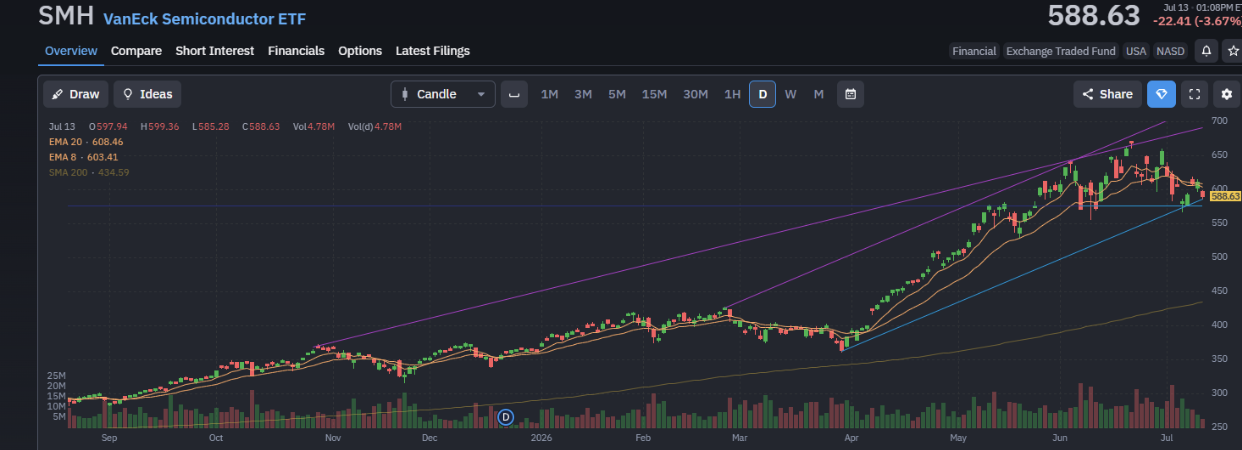
The market priced in a range, and the “scary” open didn’t even get you to the bottom of what was already expected.
So where’s the panic? I don’t see panic in this tape. I see a normal open inside a range the market already told you about, dressed up by a weekend of loud headlines.
That’s the whole lesson. The expected move is the number that tells you how much fear is priced in, versus how much fear is just noise in your feed.
When a move feels violent but doesn’t even reach the edge of the expected range, the fear is fake. The number says so.
And the expected move this week is telling you something else. It’s not anticipating much volatility at all.
That matters, because it frames every “crash” headline you’re going to read for the next five sessions. If the range is tight and the tape keeps stopping short of the edges, all that noise is exactly that. Noise.
Now, could the chips tank?
Of course they could. I’m not telling you semiconductors can’t break. The only real question is how hard everyone tries to rotate and prop them up a little longer.
At the open the answer was financials bid, oil bid, an advance decline line that held up against a red tape.
Whether that rotation lasts the session or falls apart by the afternoon is a different question. But none of that changes the discipline.
The discipline is simple. Before you trade the headline, go look at the expected move.
Ask one question. Has price reached the edge of what the market priced in, or does it just feel like it has?
Most mornings, it just feels like it. The number will tell you the truth every time, and the number does not care what the weekend headlines said.
To your success,
Don Kaufman
P.S. There’s a cost bleeding out of your options trades every single day — even when you’re 100% right about the stock. Most traders never check for it until it’s too late. My 60-second checklist shows you the 10-second catch. Get it here!