Hey trader,
Risk management separates retail from pro traders.
Yet, traders often overlook the most useful tools, not because they don’t know about them, but because they don’t understand why and how to use them.
Trailing stops have to be one of the best examples.
You’ve probably heard it’s inefficient to use one.
I disagree. Heck, I use them every day.
People who say you shouldn’t use them say they reduce your profits.
That’s the wrong way to look at it.
A trailing stop earns its keep by shrinking risk, not by locking in profit.
Used properly, it improves your overall performance.
I want to take you through the way I deploy them so you can see how and why I use them.
Why A Trailing Stop Shrinks Risk Instead Of Profit
A trailing stop moves your stop loss along behind price while the target stays put.
Nothing else about the trade changes.
Plenty of platforms will do this for you at a fixed distance.
I skip that version, because a fixed distance has no idea where structure sits on the chart.
I move mine by hand.
The stop goes where price would prove my idea wrong, and it moves only when the chart prints a new place to be wrong.
Every trade begins as a ratio. You risk a set number of dollars against a set number of dollars.
The common fix for a weak ratio is reaching for a bigger target. That asks the market to cooperate more than it already has.
Trailing the stop repairs the same ratio from the other end. Your risk gets smaller and the market has to do nothing extra.
Cutting risk in half improves your payout ratio as much as doubling your target does. You control one of those completely.
How I Trailed My Crude Stop To 84.20
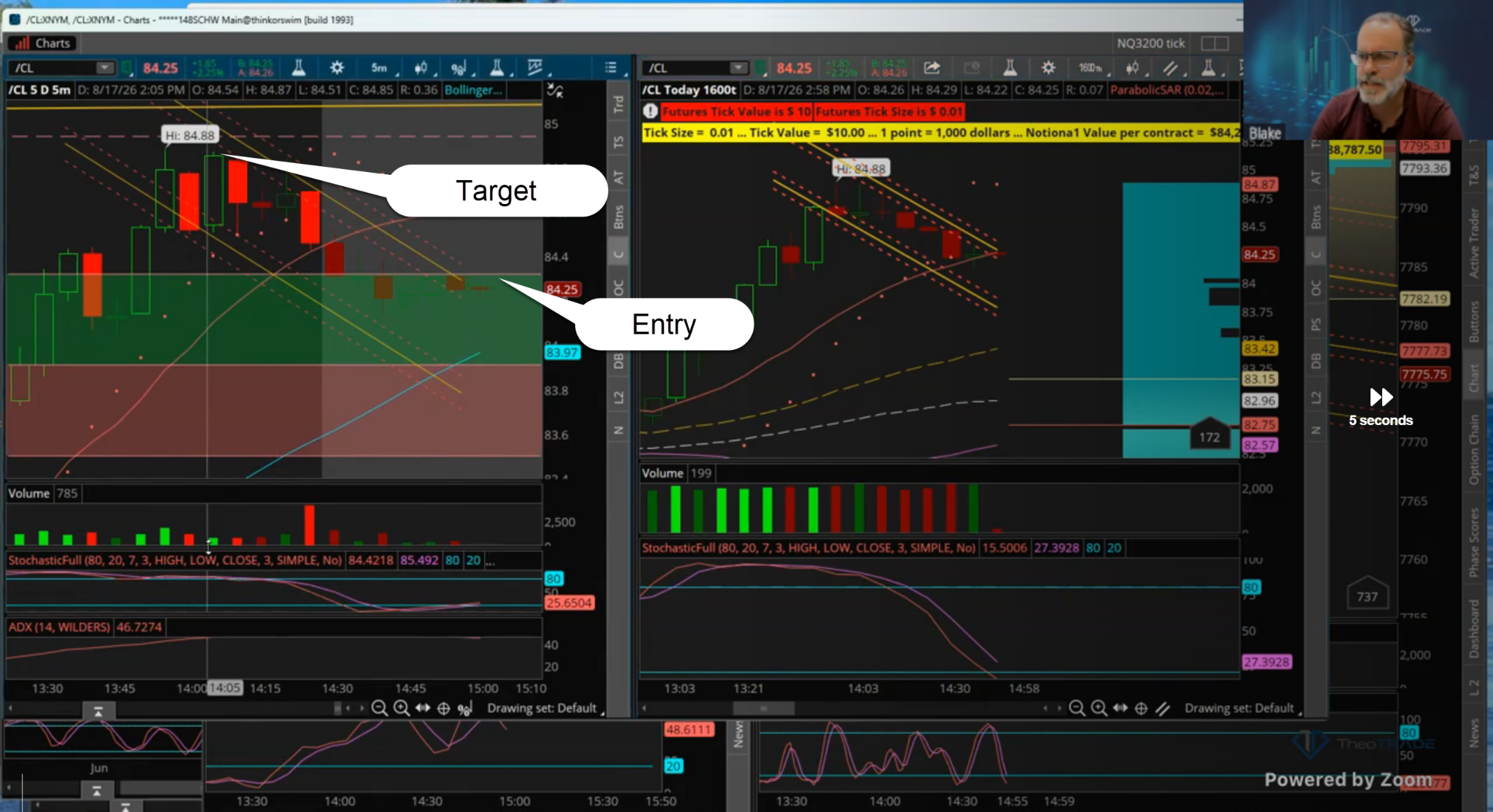
Monday afternoon, crude sat in a hidden divergence. The pullback ran from 84.88 down to 84.16 without closing back toward the point of control at 82.80.
I bought two micro contracts at 84.27. The low of that move sat at 84.05, so any print below it killed the idea.
My stop went to 84.03, two pennies under that low. Risk came to $48 on the pair.
The target was 84.80, the previous high and the peak of the indicator. That put $106 of upside against $48 of risk.
Two to one is a fine place to start a trade. The chart then handed me a way to make it better.
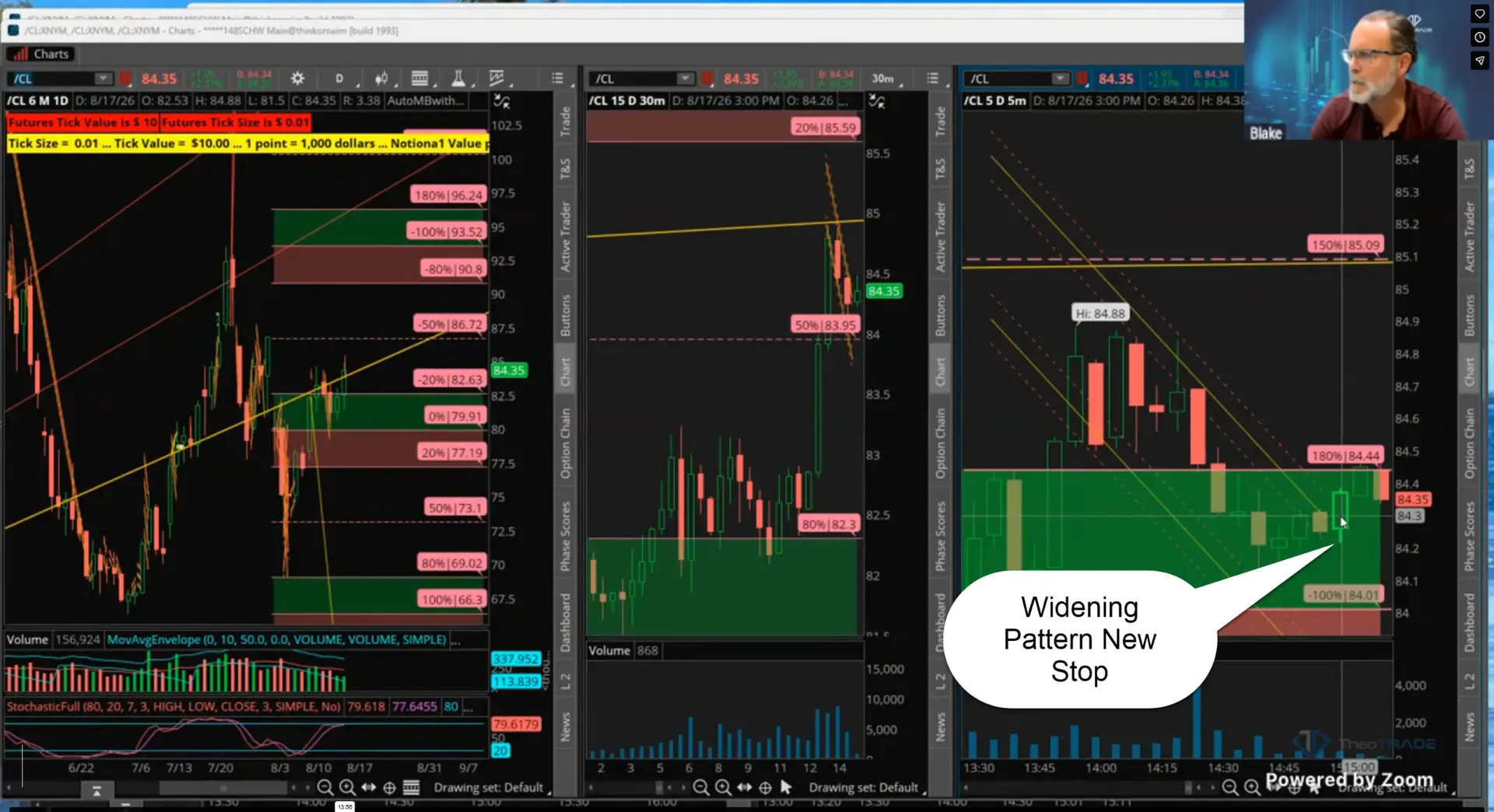
Crude pushed up to 84.48 and pulled back to 84.34. That created a widening candle with a defined low underneath it.
New structure gave me a new place to be wrong. I moved the stop to 84.20, two cents below that candle’s low.
Risk dropped from $48 to $14. The target never came off 84.80.
That reads as $106 against $14. Roughly seven to one on the same position I opened at two to one.
Nothing about my forecast changed. The market handed me a higher floor, so I stood on it.
Later in the session I was up about $26 and the instinct was to tighten again. I looked at the chart and left the stop alone, because the move up was a gap-up pullback with no fresh swing low under it.
Moving a stop into structure that doesn’t exist scratches good trades for no reason.
Crude never reached 84.80. Volume disappeared after the main session closed at 2:30 Eastern and the tape went flat.
I sold on a limit for about $30 rather than hold into dead liquidity. Crude popped higher within minutes of my exit.
That one stung. My total on crude for the day still came to $217.
The same move works on a short. I was short the Euro, missed my exit near the lows, and brought my stop down to 115.935 rather than sit there hoping.
A return to those lows would have paid roughly another $100. That position was still open when the session ended, so I cannot tell you how it resolved.
What This Means For You
Three moves you can run on your next trade.
- Place your first stop where price would prove the idea wrong, then convert that distance into dollars before you enter. My 84.05 low became a $48 number, not a feeling.
- Move the stop only when a new swing low or high prints, and set it two cents beyond that level. No new structure means no adjustment.
- Recompute the ratio after every move and leave the target alone. That is how 84.20 turned two to one into seven to one.
Run those three in order and the trail stops being a profit-taking tool. It becomes the thing that shrinks your downside while the upside stays intact.
Your Next Step
Pull up your last five losing trades. Find the swing lows or highs that printed while you were still holding.
Count how many of them offered a chance to cut risk that you never took. That number tells you what this habit is worth to your account.
Then run it live on one position. One trade, one manual adjustment, one recalculated ratio.
I closed Year One with more losing trades than winning trades and still turned $5,000 into $14,459.
453 winners against 460 losers. The account grew anyway, because I kept the losses small.
Risk under $100 per trade. Targets set at two to three times that, with stops that move only when the chart earns it.
Inside the 10% Per Month Club you watch me run it live. I am in the Private Trading Room 260 days a year, prepping at 9:45 and out by noon.
The room caps at 288 seats. You get 30 days to watch before you decide, with a full refund if you want one.
Trail the risk, leave the target alone.
Blake Young
Senior Market Strategist, TheoTRADE