Hey trader,
Friday morning, the NQ was ripping through 30 ATR and the headlines were hitting the tape every few minutes.
The room was watching, waiting for setups.
I pulled up Tuesday’s chart.
“All right. Let’s do a round of homework, you guys.”
For the next fifteen minutes, I stopped paying attention to Friday’s live tape.
I walked the Golden Setup room through every trade that printed during Tuesday’s RTH session.
Trade by trade, candle by candle. The winners, the losers, and everything in between.
This is the exercise that keeps my traders in the game when the tape gets ugly.
Why I Do This Every Week
Nine years of trading this methodology. I still pull up the tape and walk through it.
I do it because the people sitting in my room need to see the evidence for themselves.
“This is where everything is revealed. Everything. I don’t want you to take my word for it. I want you to go see this stuff for yourself.”
That is what I told the room on Friday, and I mean it.
If you take my word for it, you are trading someone else’s belief. The first time the tape goes against you, that belief crumbles.
You hesitate. You skip the trade. You chase the next one to make up for the one you skipped.
That is the FOMO cycle that eats accounts.
Homework gives you your own belief. You build it by walking forward through an actual session and watching the setups do what the rules say they are going to do.
Tuesday’s Tape, Trade by Trade
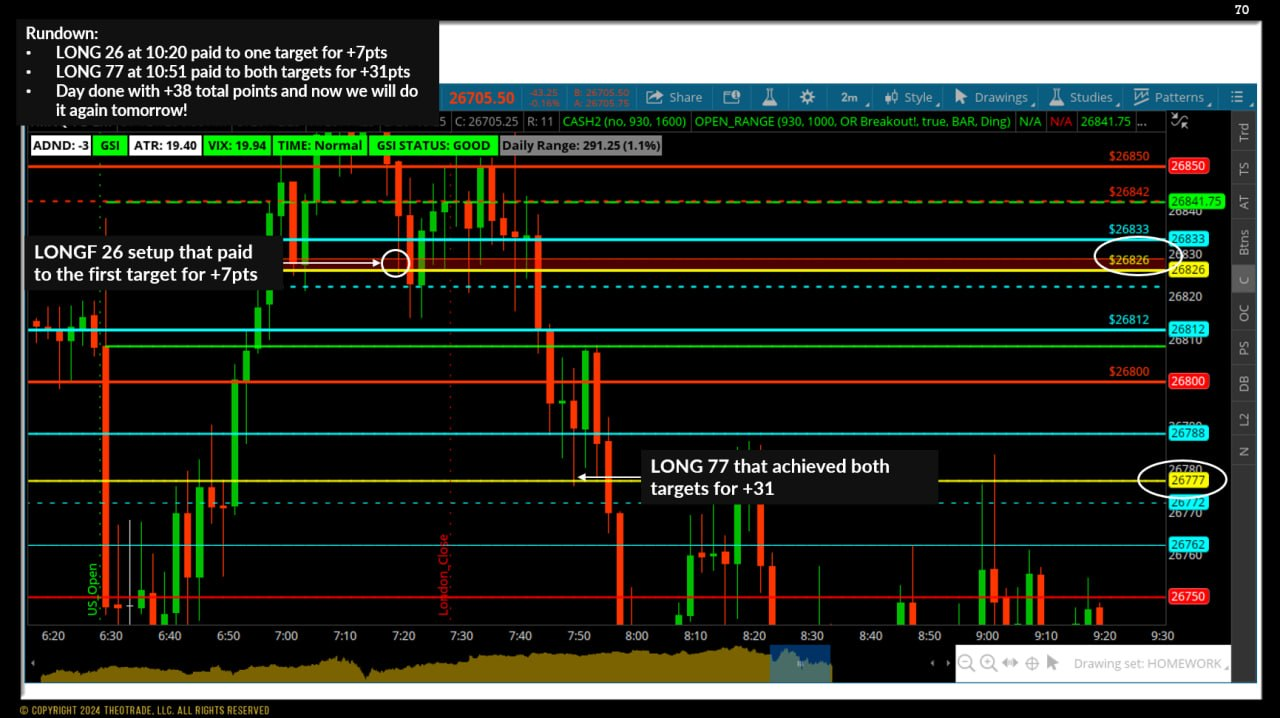
I pulled up Tuesday’s NQ on a tick chart with my levels loaded. Started at the open.
First setup of the day was a 77 short off the 50. The entry triggered and the trade ran straight to the full 31-handle target.
“Are you going to stop trading live capital? The answer would be emphatically yes, abso-freaking-lutely.”
I kept walking. Second setup was another 77 short off the red line that finished as an even stop with no damage.
Third was a plus 7 on the first target that stopped out on the reach for the second. Fourth came off a 50 that never came back and booked another full 31.
By the time I hit the seventh setup, the tally was seven for seven. 150 handles banked into the first stretch of the session.
Most of the bubble movers in the room were done for the day by that point.
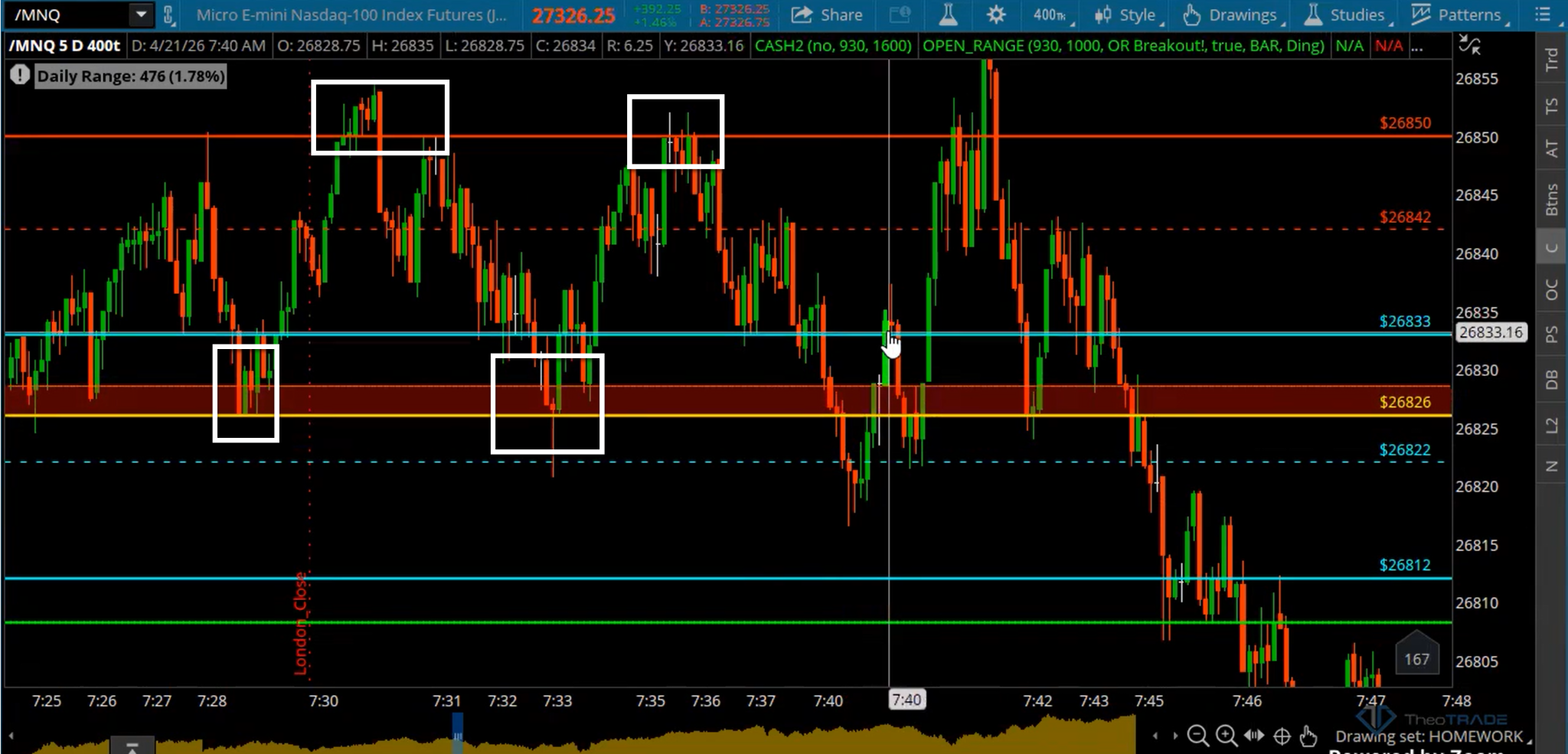
Then the eighth setup hit and took a minus 15. The ATR had expanded and the wick went too far for the escape hatch to catch it.
I did not skip past it. I rewound the candle, showed the room what had happened, and counted it in the column it belonged in.
Every profitable system produces losses. What matters is whether the rules are managing those losses the way they are supposed to.
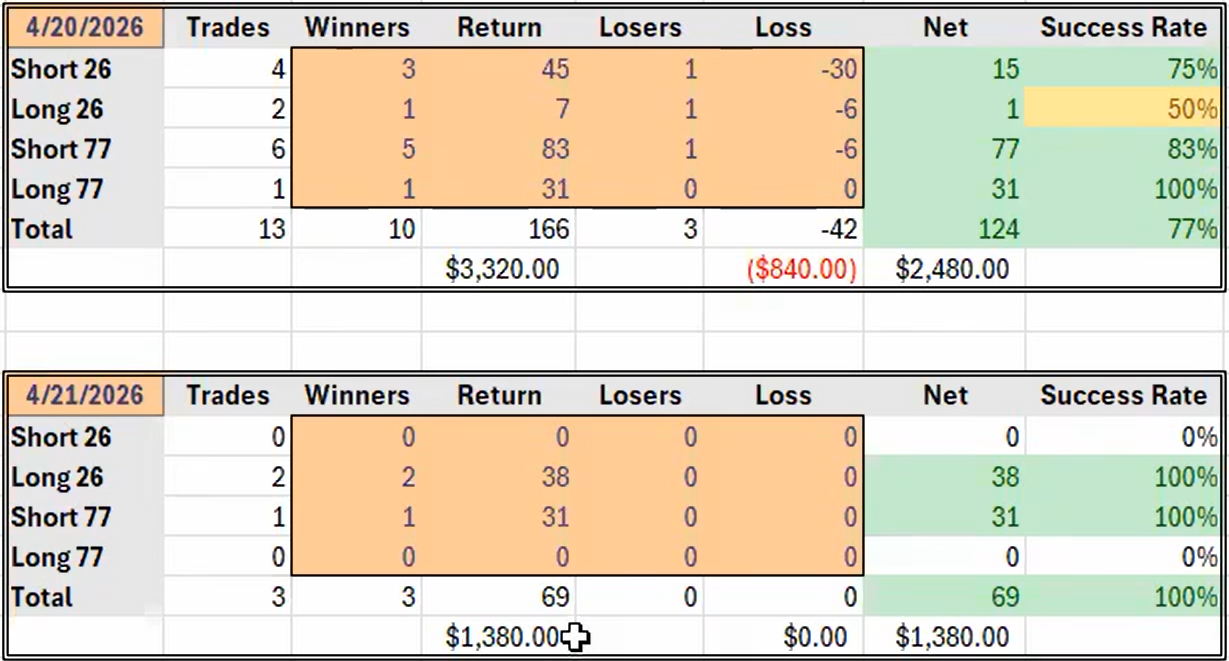
By the close of Tuesday’s RTH session, the numbers looked like this. Twenty-seven trades, nineteen winners, eight losers.
300 handles captured on the buy side. About a hundred given back to stops and minus threes.
Net, a big clean day.
“That’s your FOMO tool for doing this. That is your process to say, dude, this stuff works. I need to keep doing this. I need to master this.”
Why the Losers Matter As Much As the Winners
Here is what most people miss when they sit in a live room.
They watch me book a 31 on the first trade, take a plus 7 on the second, and they start feeling like this should be easier. They start wondering why their own hands are shaking on the entry bar.
They start reaching for trades that are not their setup.
Homework fixes that.
You see the eight losers sitting next to the nineteen winners. You see the escape hatches that pulled me out of bad trades for a minus three instead of a minus fifteen.
You see the even stops that saved green trades from going red. You see the plus 7s that banked partial wins when the second target did not fill.
The system is not all sunshine. It is a probability-based framework that wins more than it loses when you follow the rules, and the homework shows you that with your own eyes.
How to Run It This Weekend
Pull up the NQ on a tick chart for any recent RTH session. Load your Golden Setup levels.
Walk forward one candle at a time from the open. Every time a red line or a 50 triggers a setup, mark the trade.
Log the entry, the stop, and the outcome. Five possibilities to track: full 31, plus 7 stop-out, even stop, escape hatch exit, or full stop loss.
Tally it up at the end of the session.
If you want to go deeper on the psychology side, pick up Mark Douglas’s book “Trading in the Zone.” It costs fourteen dollars on Amazon and is also available on audiobook.
Douglas wrote about probabilities and emotional detachment years before I ever mapped out this methodology. The two frameworks reinforce each other almost completely.
“Best $14 you ever spent if you’re going to play this game.”
Coming Into Monday
Friday’s live tape was a grinder for me. I took stops and gave back handles I had banked earlier in the week.
I said so to the room and I am saying it here.
The traders who sit down this weekend and run the homework on last week’s sessions will walk into Monday with something I cannot hand them from the front of the room.
They will walk in with their own belief in the setup. That belief is the thing that holds when the tape gets ugly, the ATR expands, and the headlines start flying.
See you in the room Monday.
Trade smart,
Tony Rago
Creator of the Golden Setup