Hey trader,
People think it’s safe to sell iron condors. The risk is capped. It also seems cheap to put on, apart from the commissions.
I don’t like them. I never sell iron condors.
They’re long-run losers. They’re costing you money if you keep selling them.
I know that sounds odd coming from me. After all, an iron condor is just a put vertical spread sold below the stock and a call vertical spread sold above it.
Those two spreads carry something called negative expectancy. It sounds like a mouthful. It just means you’ll lose money over time if you keep taking the trade.
BUYING an iron condor is a different ballgame. That’s one I’m willing to play.
Why does a “safe” trade lose money over time?
The volatility curve holds the answer.
How a Coin Flip Explains Expectancy
Expectancy is what a trade makes or loses on average if you keep taking it. You can figure it with one line of math.
Take the odds of winning and multiply them by the potential profit. Then subtract the odds of losing multiplied by the potential loss.
A coin works well here, since it lands heads or tails at 50/50 odds.
Here’s what happens to a $1 bet on that coin at three different payouts:
- Win $1 for every $1 bet: 50% × $1 minus 50% × $1 comes to $0. You break even over the long run.
- Win $1.01: The same math comes to $0.005 per flip. You’ve got a money-making machine, albeit a slow one.
- Win $0.99: Now it’s −$0.005 per flip. Keep flipping and you’ll eventually go broke.
Casinos live on that last line. They take a small edge and multiply it over millions of transactions.
A negative-expectancy trade puts you on the player’s side of that table. Any single trade can look harmless. The losses pile up the longer you keep taking it.
Why You Lose When You Sell Iron Condors
Every option carries implied volatility. That’s basically the movement the market prices into it, and more of it makes an option more expensive.
The volatility curve plots that number across every strike. Its shape decides which side of a condor gets the better deal.
When the curve forms a smile, volatility runs lowest near the stock price. It climbs on both sides as the strikes move further away.
So, when you sell iron condors it means selling the strikes near price and buying the ones further out as protection. On a smile, I’d be selling the low volatility and buying the high volatility.
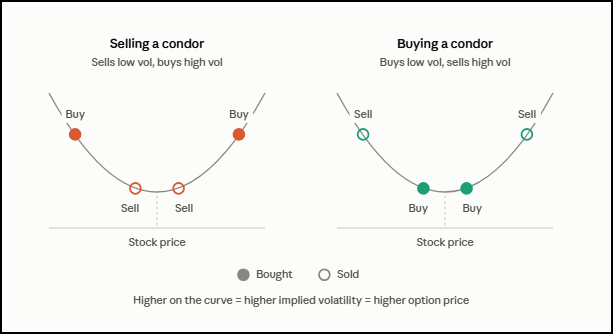
That’s the $0.99 coin. I’d be selling the cheapest options on the curve and paying up for the richest ones.
Buying the condor reverses every leg. I buy the low volatility near price and sell the high volatility further out.
That volatility difference gives me an edge. It moves me toward the $1.01 side of the flip.
What Today’s Expiration Showed Me
I pulled up product depth for today’s expiration during my session. The curve showed a smile with no skew.
Skew basically means one side of the curve runs richer than the other, usually the puts. Today, neither side was tilted.
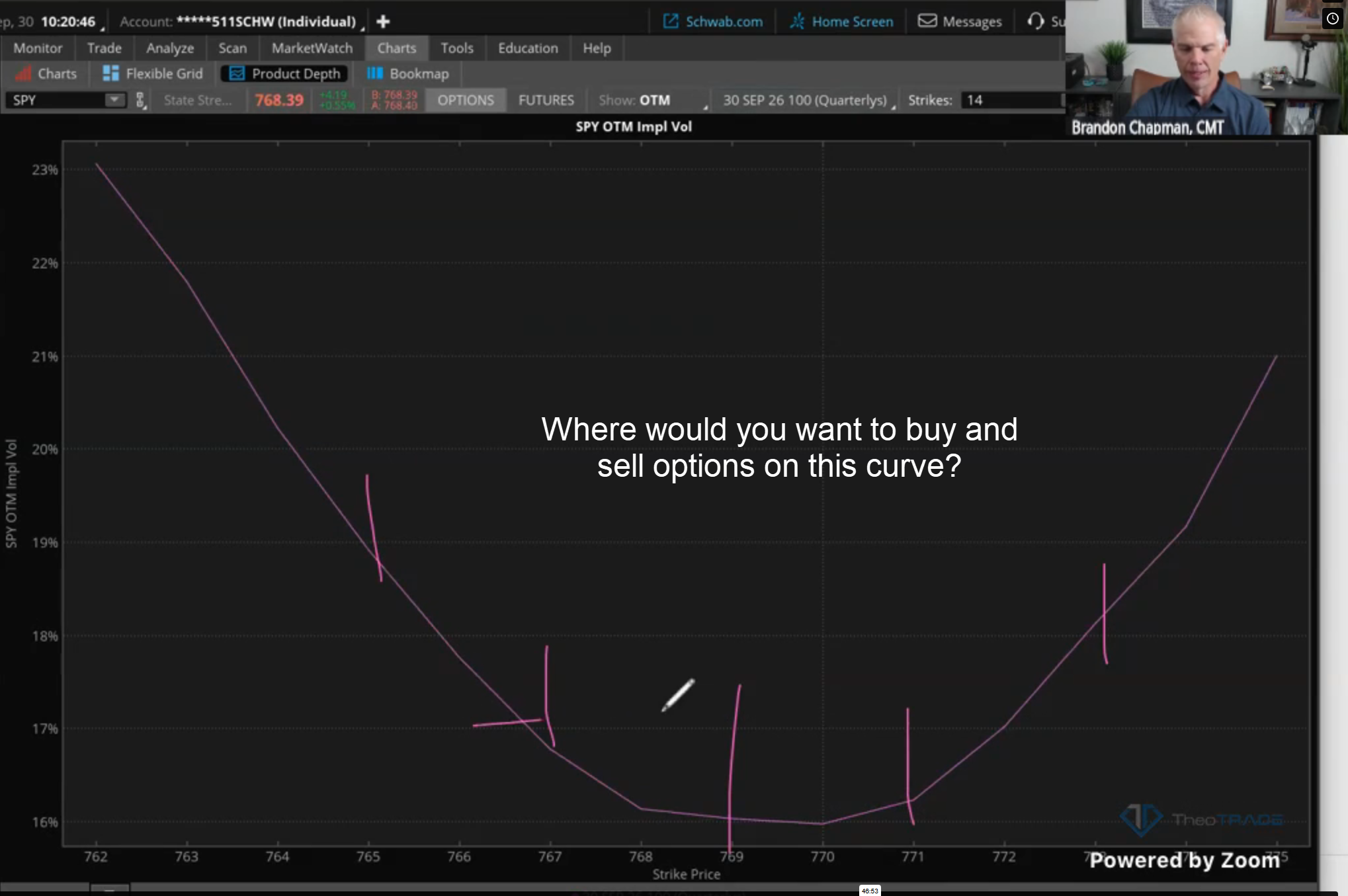
With that shape, a long condor let me buy the low volatility near price and sell the high volatility on the wings. The pricing leaned my way.
The cost shows up somewhere else. A long condor needs bigger moves to pay off.
It makes money when price travels past the strikes I bought. A quiet day that pins price in the middle works against it.
That’s why I say buying a condor can work. It has the potential for positive expectancy, which almost never happens when you sell iron condors.
The One Time Selling Can Work
Selling an iron condor can show positive expectancy in one circumstance. Volatility has to be really high.
In that case, the wings might be really wide, and volatility can collapse. A lot of times, a big move still really hurts the position.
I still don’t sell iron condors there. In a high-volatility environment, I’d rather just sell puts.
Put verticals on their own are a negative-expectancy trade on a product like SPY. A volatility crush can raise the expectancy of that trade.
A volatility crush basically means implied volatility falls fast. The options I sold lose value quicker when it happens.
Before you sell iron condors, check which side of the curve you’re buying and which side you’re selling. Selling the cheap strikes to buy the expensive ones hands the house its edge.
Brandon Chapman, CMT
Creator of Ghost Prints