Hey Trader,
Not all Treasury bonds are created equal.
Lend the government money for three months and you get one rate. Lend it for 30 years and you typically get paid more.
I want you to look at that extra yield and know if it’s worth taking. I’ll also show you where I park my own safe money while rates climb.
The decision rests on one number. Bond traders call it duration.
Duration measures how hard a bond’s price gets hit when interest rates move. It’s the risk you accept in exchange for the higher yield.
A one-year T-bill barely reacts. Your chance of losing money on it is negligible.
Stretch out to a 30-year and that chance turns humongous.
Look at what’s happening right now. The 30-year Treasury Bonds are in free fall.
Hedge funds are already on top of this. Some high-profile names just moved 10% to 30% of their money into government debt.
They bought the shortest duration they could find. They want the yield without the duration risk.
I never buy anything in free fall. You’d be a fool to buy 30-year Treasury Bonds here.
The extra yield doesn’t come close to covering the risk. Let me walk you through the math I run before I lend anybody my money.
Duration Decides How Much That Yield Costs You
Every bond carries duration risk. You decide how much of it you hold.
Duration measures a bond’s price sensitivity to interest rate moves. A T-bill’s price barely budges when rates shift by a few basis points.
The 30-year moves hard on the same news. Duration is everything when you’re deciding what to buy.
One rate move, three very different losses.
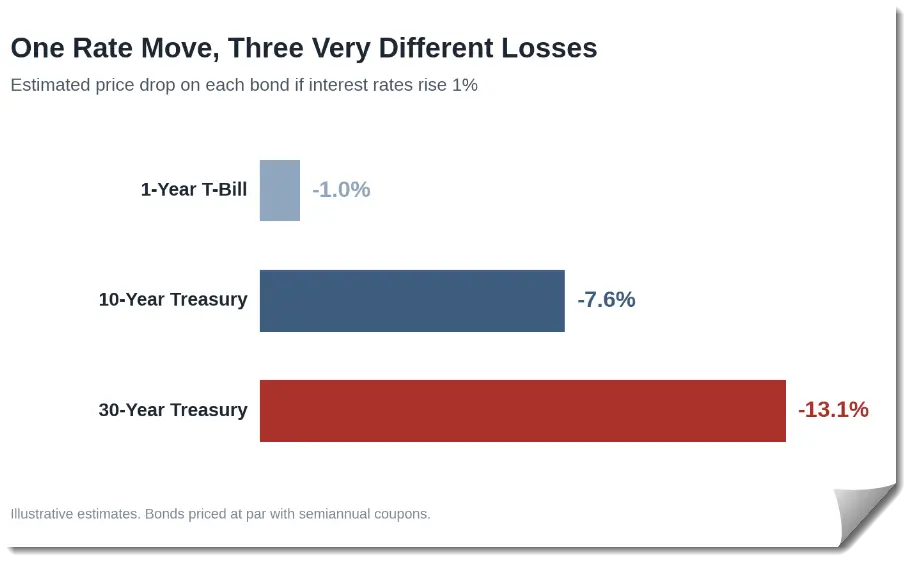
Think of duration as the length of your exposure. The longer your money stays locked up, the more rate moves it has to survive.
Your chance of losing money on a one-year Treasury is negligible. On a 30-year, that chance turns humongous.
That extra yield is your payment for carrying 30 years of rate risk.
How I Decide Whether The Extra Yield Is Worth It
I want to know one thing before I lend anybody my money. The extra yield has to cover the extra risk I’m taking.
Gianni Di Poce laid out the math on our session. The 30-year yields about 5.5%, roughly 1.5% more than a one-year T-bill.
You’d tie up your money for 29 more years to collect that extra 1.5%. That trade doesn’t work for me.
That’s roughly $15 a year on every $1,000 you lend. You’d collect it while carrying three decades of rate risk.
Short duration is what you want in a rising rate environment. The Fed raised rates another 25 basis points.
Don Kaufman likes a trade on ZB. I respect that call.
For my own safe money, I’ll take short duration.
If I were advising any of you, I’d keep your safe money short. Duration is everything right now.
Why I Won’t Touch The 30-Year Treasury Bonds Right Now
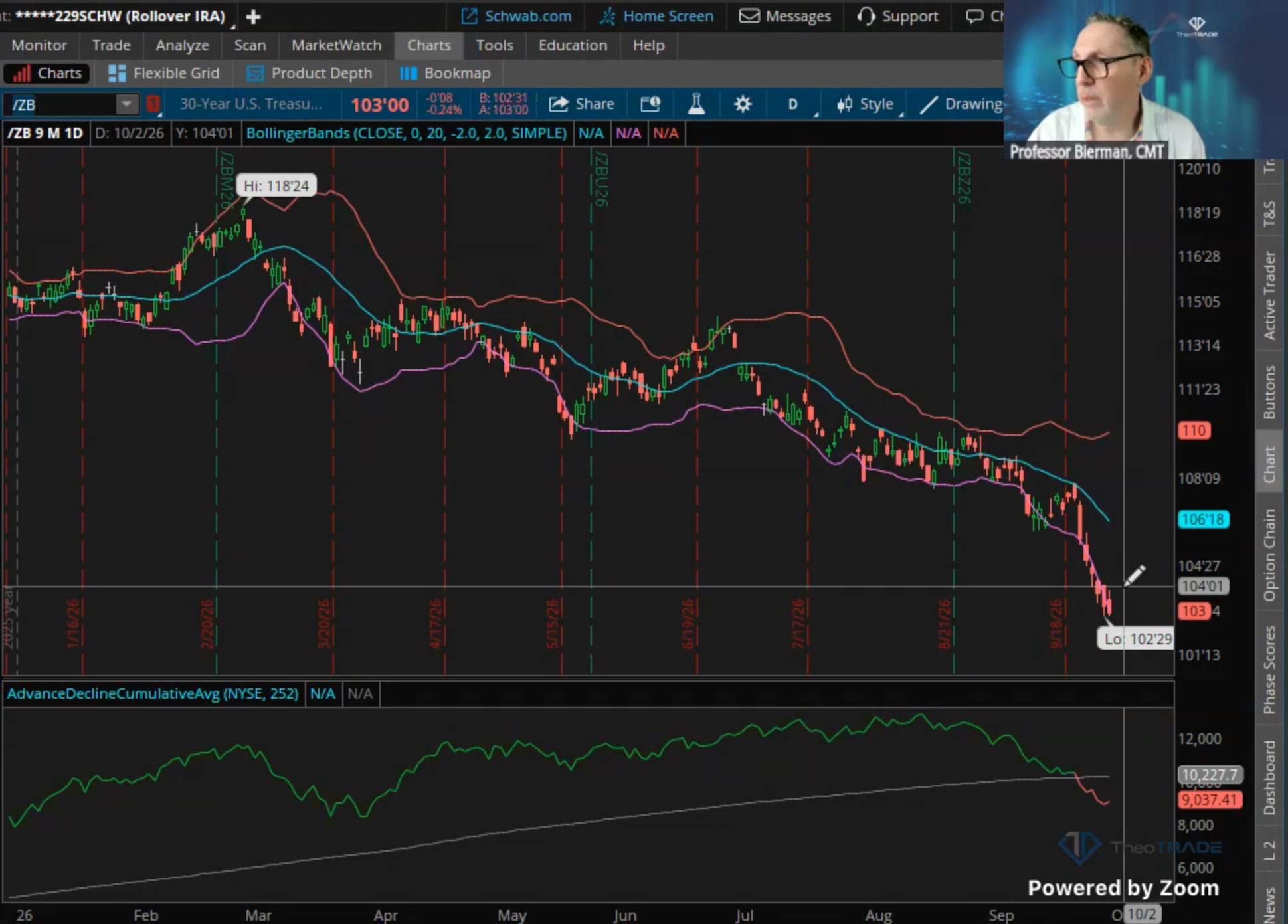
Pull up the ZB chart and you’ll see that 30-year Treasury Bonds are falling. I don’t buy anything in free fall.
Take it down to 70 and I still wouldn’t buy it.
The hedge funds I mentioned are moving the same direction. They expect volatility to pick up without calling which way.
They’re cutting their long stock exposure. The money they pull out goes into the shortest T-bills they can buy.
Some of those funds now run about 70% in stocks and 30% in T-bills.
They wanted the yield. They didn’t want the duration.
Where I Park My Own Safe Money
I buy T-bills directly through Treasury Direct. I also hold CDs, which carry zero principal risk because the FDIC backs them.
I don’t lose sleep over either one. Both of them let me collect yield while I wait.
Neither one punishes me when rates move against the long end.
Treasury Bonds carry one more advantage. You don’t pay state or local tax on the interest.
I still get taxed on the money I lend the government. That one never stops bothering me.
Municipal bonds go further. They’re tax-free across the tiers, so check your own tax situation before you pick one.
Here’s what I’m watching for next. I expect rates to hit a crescendo point where low-risk money pays 5% to 6%.
Money gets forced out of the S&P 500 at that point. Investors will take the sure thing over stocks.
Run the math on $2 million earning 6%. That pays you $120,000 a year.
You’d want that inside a tax-shielded account. Otherwise, the tax bill eats into it.
That’s the same question I ask before every trade.
I want to know what an investment pays me. I also want to know what it costs me to own it.
I built the Genesis COG System around that order of work. The numbers come first, and the chart comes second.
You can run the same check on a bond, a stock or a CD.
It teaches you to weigh the reward against the risk before you commit a dollar. You stop reaching for yield or price without knowing what it can cost you.
Rates are still climbing. You’ll want that process working for you before the crescendo point arrives.
Enroll in the Genesis COG System
Professor Jeffrey Bierman
Creator of the Genesis COG System