Hey trader,
When the tape turns ugly, the instinct is to reach for a stop or dump shares into the fear.
That move feels safe. It is usually the expensive one.
There is a quieter option….
I can hedge a portfolio so the downside is nearly erased, and structure it to cost me almost nothing out of pocket.
My morning read on the print tape shows institutions running this same play right now.
They are buying puts and selling calls, because the premium on downside protection has climbed to a level worth selling against.
I’m going to walk you through the exact structure on a $100,000 account.
The part that surprises people is how little upside you actually surrender to get it.
Here’s how it works.
A Hedge Is Not Built To Make Money
Start with the purpose of a hedge. It exists to limit how much you lose when the market falls, nothing more.
Judge it by the drawdown it prevents.
A hedge that costs a fortune defeats its own purpose. The real work is making it cheap.
The protection itself is a put. A put gains value as the market falls, which offsets the losses on your shares.
To pay for that put, I sell call options stacked above the current price. Those calls hand me premium I keep, as long as the market does not surge past them.
This is not a theory I dreamed up.
The print tape shows institutions buying puts and selling calls right now, because the price of downside protection has climbed to a level worth selling against.
The Structure On A $100,000 Account
Let me make this concrete.
Picture a $100,000 account in an S&P 500 index fund, with the ETF trading near 753.
That money buys about 132 shares. Each one dollar move in the market then hands you or costs you $132.
That figure is your delta.
I want to take roughly a third of it off the table, somewhere between 40 and 44 deltas, using puts.
So I buy two put options about 30 days out, at the July expiration, near the 733 strike. Each one runs me roughly $5.34. That is the price of the insurance.
Now comes the part that pays for them. I sell four call spreads, each six points wide from 762 to 768, collecting about $2.43 apiece.
Here is how it nets out. The credit from those four spreads covers nearly the full cost of the two puts.
The protection ends up close to free.
What You Keep And What You Give Up
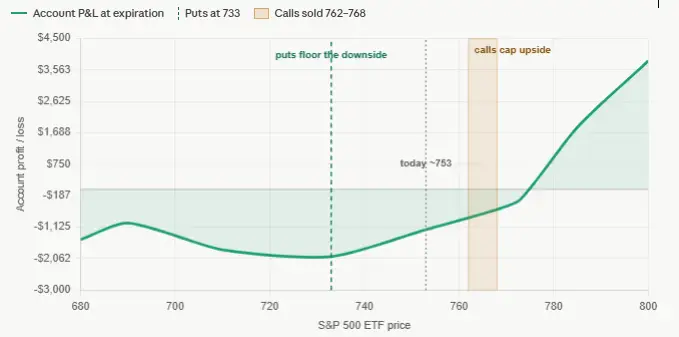
Here is what that structure does to the account: from about 690 on the downside up to roughly 770, your profit and loss runs nearly flat.
Picture a tabletop. Down 60 points or up 20, you barely move.
The downside is the headline. A fall all the way to 690 costs you almost nothing, since the puts gain as your shares drop.
The price you pay sits near the top. You give up about 18 points, call it 2.5 percent, in the zone just overhead.
Past roughly 773, you keep all of it again. Every dollar of gain above that line is yours, with the hedge out of the way.
This is where rolling earns its keep. As the market falls through your put strike, you close it, then buy a fresh one lower at a 30 delta.
Each roll pulls a little cash back out of the position. Done patiently, those rolls can cover the hedge entirely and leave you protected at no net cost.
When This Hedge Falls Apart
One warning before you run it.
This hedge fits a portfolio that moves like the index. It falls apart on the wild stuff.
Names like SpaceX and the high-flying speculative tickers carry volatility four to five times the S&P 500. At 100 percent volatility or higher, their moves are simply too big to cover this way.
If your account is stuffed with those, you hedge them one at a time, or you trim and take profits. For this structure, you want holdings that track the index, with two to three times its volatility at most.
Here is the framework as I would set it up. Treat it as a template, since the exact strikes depend on the day and where volatility sits.
- Setup: a portfolio that moves with the S&P 500, with the index ETF near 753 standing in for $100,000
- Structure: buy two 733-strike puts about 30 days out near $5.34 each, sell four 762/768 call spreads for about $2.43 each
- Cost: close to zero, since the call spread credit nearly covers the puts
- Protection: downside flattened from the current price down to about 690
- Trade-off: roughly 2.5 percent of upside surrendered in the zone just overhead, with full gains again above 773
- Edge: index volatility is low enough to make the puts affordable, while the skew is high enough that selling calls pays well
- Maintenance: roll the puts down as the market falls to pull the cost back out
One more reason this matters now. The volatility readings I track just hit their highest level since May 14, the day the last major top formed in names like Nvidia.
That backdrop is the whole argument for protection. With the structure under the market this fragile, paying almost nothing to erase your downside is about as good as it gets.
Brandon Chapman, CMT
Creator of Ghost Prints