Hey Trader,
I know a few arb guys. When a stock gets added to the S&P 500, they load the boat short and head out.
They short it at 280 and leave the office in ten minutes. They already know how it ends.
Every index fund and every index-mimicking fund has to buy that stock. They have no discretion at all.
The mandated buying dries up fast. Then the zero DTE crowd takes 10 or 15 dollars out of it the next morning.
Bloom Energy is doing this today. The stock is up big on the addition alone.
The earnings didn’t improve. Insiders bid it up before the announcement, so today’s buyers are the last to learn.
I’d sell it. If you bought it this morning, I’d fire you.
Let me tell you what’s in the article.
I’ll walk you through the three-day rule that hands this stock back to 230.
Then I’ll show you how to separate a forced bid from real demand on any chart. That read decides whether you hold a gap or dump it.
These additions come around all year long. They’re one-day wonders, and they behave the same way every time.
I’ll also price the 275 straddle. You can collect the reversal without betting on direction.
I call this setup the Bloom Balloon. Index funds have to buy it…
…Nobody has to hold it.
What An Index Addition Does To A Stock
An index addition forces buying. It rewards nobody for running a better business.
Every fund tracking the S&P 500 has to own the new name. Every index-mimicking fund has to own it too.
Those buyers have no discretion. They buy on a schedule, and the schedule ends.
Bloom Energy is rallying while its earnings aren’t getting better. The move is purely structural.
People on the inside already knew about the addition. They bid the stock up ahead of the public announcement.
The last to learn are the ones who have to buy today.
How To Tell A Forced Bid From Real Demand
The tell is how long the buying lasts. Three questions settle it on any chart:
- Whether an index headline caused the move or a company result did
- Whether the earnings improved during the reporting period
- Whether the buying ran for days or landed inside one session
Sun Life Financial shows you the honest version. Somebody loaded the boat on that name on 8/24, and the buying kept going for days afterward.
That’s a reason not to short something. Institutions were accumulating, and accumulation leaves a trail across the tape.
A forced bid leaves no trail. It arrives in a single session, then the tape behind it goes quiet.
Now put the levels on Bloom Energy. The stock sat at 278, then 275 when I priced the options, and the arbitrage desks were shorting it at 280.
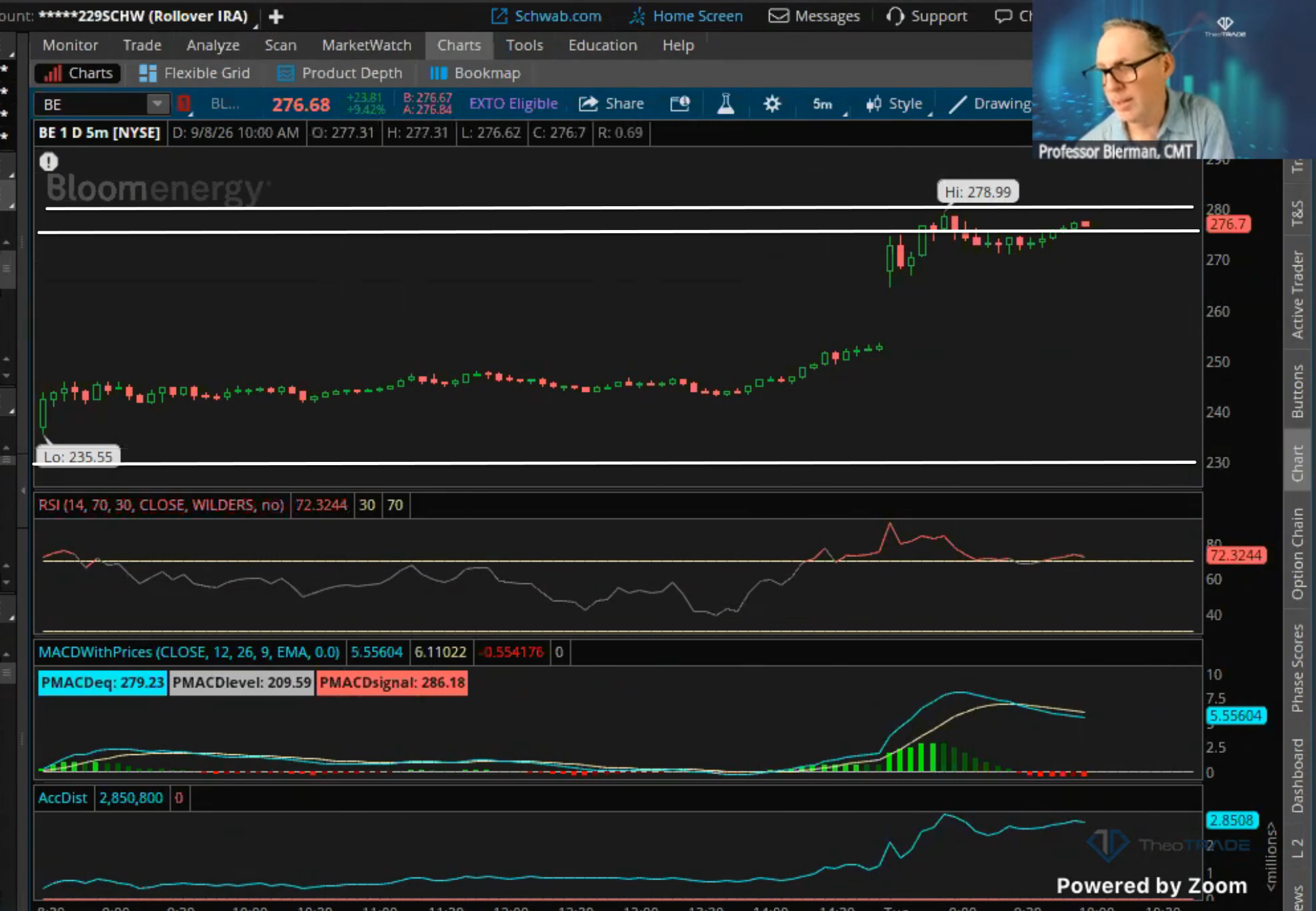
Then check how far this stock travels in a normal stretch. It ran 43 points inside 17 days and 51 points inside 24 days.
How The Three-Day Rule Runs
The balloon deflates in stages rather than all at once. I call it the three-day rule.
Day one is the lift. The mandated buyers fill their orders, and the arbitrage desks get short into that demand at 280.
I know a few arb guys. They load the boat short, leave the office in ten minutes, and come back the next morning.
The next morning is stage two. Once the zero DTE traders wake up, they take 10 or 15 dollars out of it.
Three days out is stage three. Watch it work right back to 230.
So the overnight drop and the 230 level aren’t two competing forecasts. They’re the first move and the finish of the same slide.
Why A Straddle Beats The Short Here
I hate shorting a stock on the way up. That’s why I’d let this one consolidate a day or two before taking it short.
The straddle gets you around that problem. You buy the call and the put at the same strike, then you stop picking direction.
Now run the arithmetic before you like the idea. The 275 straddle costs 42.05, so the stock has to travel roughly 42 points either way.
Set that against the 230 level. From 275, that’s a 45-point drop against a 42-point breakeven, which leaves you almost nothing.
The expected move into Friday is only 11 dollars. That figure is one standard deviation, so a single week won’t get you there.
The deeper handle I’d watch sits at 163. A slide from 275 down to 163 clears the breakeven with real room behind it.
The strike isn’t what matters on a straddle. The expiration date is.
Price it against how this stock actually moves. A 43-point run took 17 days, so 17 days is the shortest window that has produced your breakeven.
The trade also works inverted. If you think the stock gives back only 25 or 30 points and then holds a range, you sell the straddle and collect the volatility compression.
How You Use This Tomorrow
Start with the reason for the gap. Pull up any stock that jumped and find out what caused the move.
When the cause is index membership, the bid has an expiration date. You then have three responses worth considering:
- Sell into the pop if you already own the shares
- Let it consolidate a day or two, then take the short
- Price the straddle against the deeper level and the days you’d need
Adding to the position is not on that list. You’d be buying alongside the one group of buyers who have no choice about being there.
Write down the level the stock returns to before you commit. On Bloom Energy that number is 230, and it turns a guess into a measurable target.
A forced buyer is not a believer. Find out who has to buy before you decide what it’s worth.
That question is easy to answer on one stock. There are 14,000 of them I can choose from, and I track thousands every session.
So I don’t hunt for opinions. I look for the setup, I look for the footprint, and then I dive in.
Genesis COG was long Medtronic at 80 and out at 94. We took 14 points out of it, then walked away before earnings.
That trade came from the same read I just showed you. Somebody was buying, and then somebody wasn’t.
Skyworks paid us 118%. Etsy went in and out inside 24 hours.
None of that required a forecast. It required knowing which bid was real.
The Genesis COG System is the whole model. You get the valuation work, the entry and exit rules, and the volatility mapping that prices a straddle before you risk a dollar.
I’m running it live every session, and enrollment is open right now.
Professor Jeffrey Bierman
Creator of the Genesis COG System